Trainz Railroad Simulator

Please read this if you haven’t.


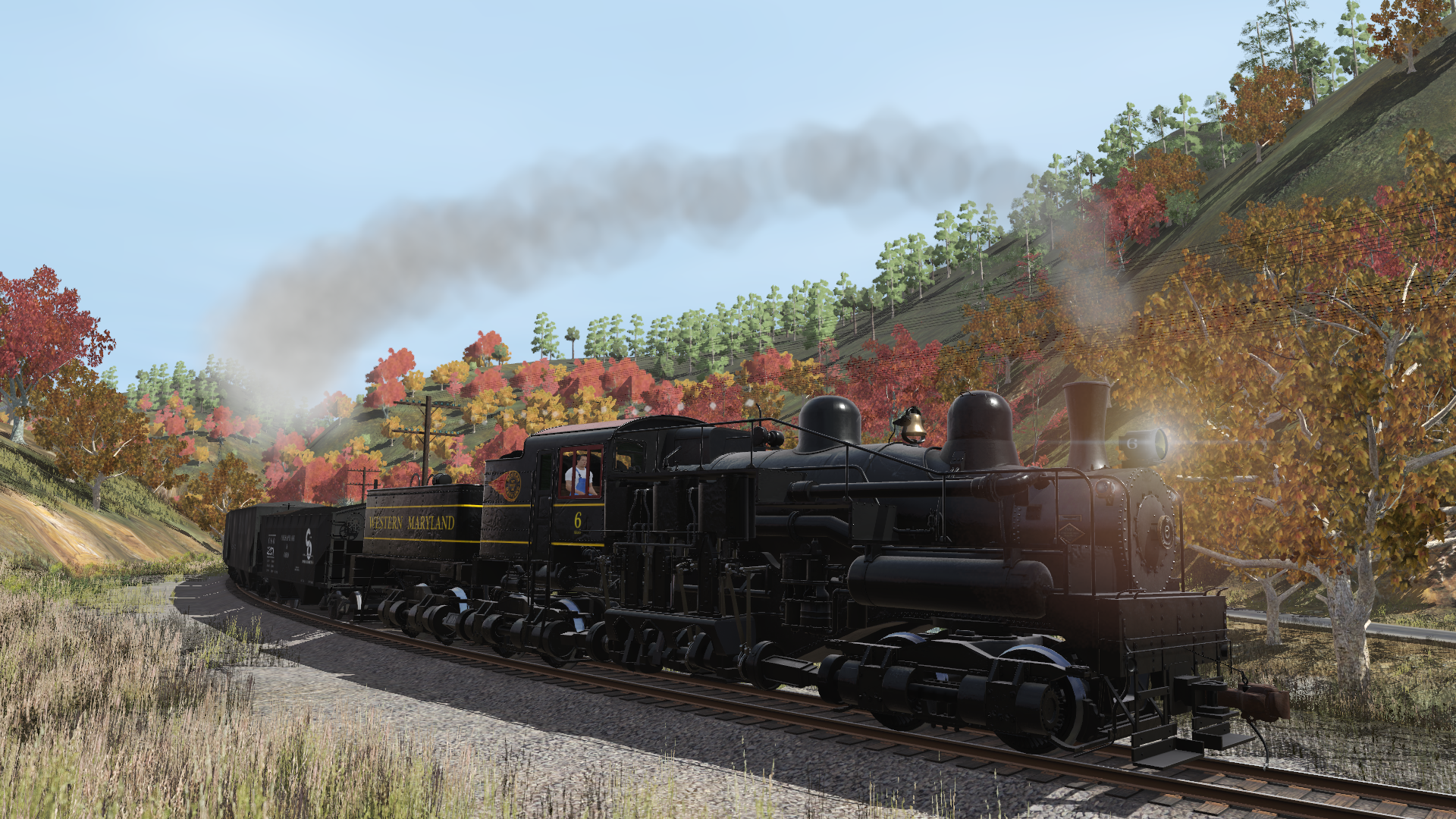
Western Maryland Shay No. 6 was built by the Lima Locomotive Works in 1945 for the steep grades of the Chaffee Branch, between Chaffee, WV, and Vindex, MD. The locomotive spent just four years in active service hauling coal for the railroad before retirement. The “Big 6” earns the distinction of being the last and second-largest of 2,767 Shay locomotives built. Following retirement, the locomotive was donated to the B&O Railroad Museum in Baltimore, MD where it resided for more than 26 years. A trade arrangement was made with the State of West Virginia for the locomotive in 1980 in exchange for Cass Shay No. 1 and a Porter 0-4-0T.
Includes
2 WM Engine C-150-3 Shay Locomotives (2 Variants)
Custom Cab
MISSING DEPENDENCIES ISSUES
Check Download Station for extra missing content
TRS19
Please backup your downloads upon purchase! Check the FAQ section for more information.
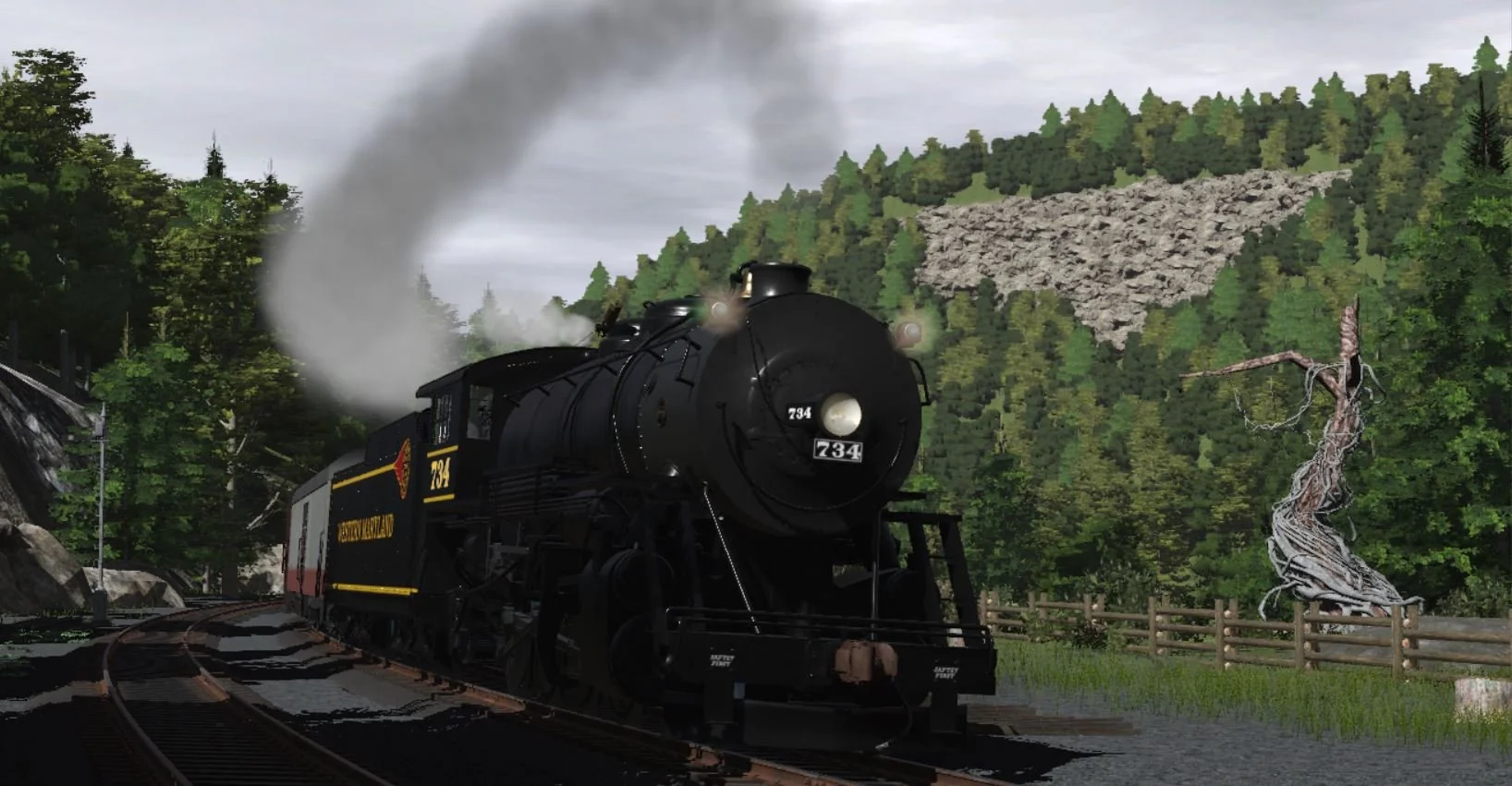
The Western Maryland Scenic Railroad No. 734 is a preserved class "SC-1" 2-8-0 "Consolidation" type steam locomotive originally built by the Baldwin Locomotive Works in 1916 for the Lake Superior and Ishpeming Railroad. The locomotive was built for service as a dock switcher and was originally LS&I No. 18. In 1924, the LS&I purchased the Munising, Marquette & Southeastern Railroad and the engine was renumbered to No. 34. It served the LS&I until it was retired from revenue service in 1961. In 1963, it was sold to the Marquette and Huron Mountain Railroad, but never operated under the M&HR flag. In 1971, the locomotive was sold to the Illinois Railway Museum for static display. Today, No. 734 is owned and operated by the Western Maryland Scenic Railroad in Cumberland, Maryland

The I-2 Decapods built for the Western Maryland Railway were the largest ever built, at almost 420,000 lb (190 t) weight, and are a notable exception to the general rule of thumb for the comfort of the ride on a 2-10-0 wheel arrangement, crews said the engines cruised smoothly up to 50mph without becoming a rough ride. (After the running gear was redesigned by the WM) The WM's I-2 are also noted as the strongest Decapods ever built, at 96,315lbs of tractive effort.
Includes
3 Western Maryland Decapods
2 Tender Variants
Custom Cab
MISSING DEPENDENCIES ISSUES
Check Download Station for extra missing content
TRS19 and above
Please backup your downloads upon purchase! Check the FAQ section for more information.


In 1912, the Baltimore and Ohio railroad would produce 4 C-16 saddle-tank locomotives. Numbered 96 through 99 these engines were built to run B&O's Pratt Street line, a small industrial railroad running from the B&O's Mount Claire shops, to Baltimore's piers. To comply with city ordinance these engines would burn oil, and operate only after dark. Their short wheelbase length allowed them to operate through cures as tight as 82 degrees, something needed to operate the tight streets, alleys, and piers of Baltimore. In late 1912 numbers 96 and 99 would have their oil bunkers replaced with coal bunkers and in 1926, both would be have their tanks removed entirely and be turned into tender engines classified as C-16a. In 1950 97 and 98 would be re-numbered to 897 and 898 to make room in the numbering system for the oncoming diesels, they would be scrapped the following year. The engines included in this pack represent engines 97 and 98 in their everyday appearance between 1920 and 1950.
Includes
3 Baltimore & Ohio C16 Locomotives (3 Variants)
Custom Cab (All of my locomotives will have custom cabs)
MISSING DEPENDENCIES ISSUES
Check Download Station for extra missing content
TRS19
Please backup your downloads upon purchase! Check the FAQ section for more information.

The Baltimore and Ohio's S-1a 2-10-2s (also known as the "Big Sixes") where built in 1923, and where an upgrade to the 1914 built S class locomotives. The S-1a's (#6100 - 6224) sported larger drivers than the previous 2-10-2s, as well as other improvements to the early design. While most 2-10-2s where built for low speed dragging, the S-1a's where able to pull heavy trains at higher speeds, making them perfect engines for the B&O's Sand Patch Grade. Seen both hauling heavy drag freights as well as serving as helper engines, the S-1a's would remain in service to the very end of B&O steam.
Includes
6 Different Skins
B&O Tender
Custom Cab
Creators
Dennis - Modeling
Elijah - Texturing & Coding
TRAINZ 2019 and up!
Please backup your downloads upon purchase! Check the FAQ section for more information.
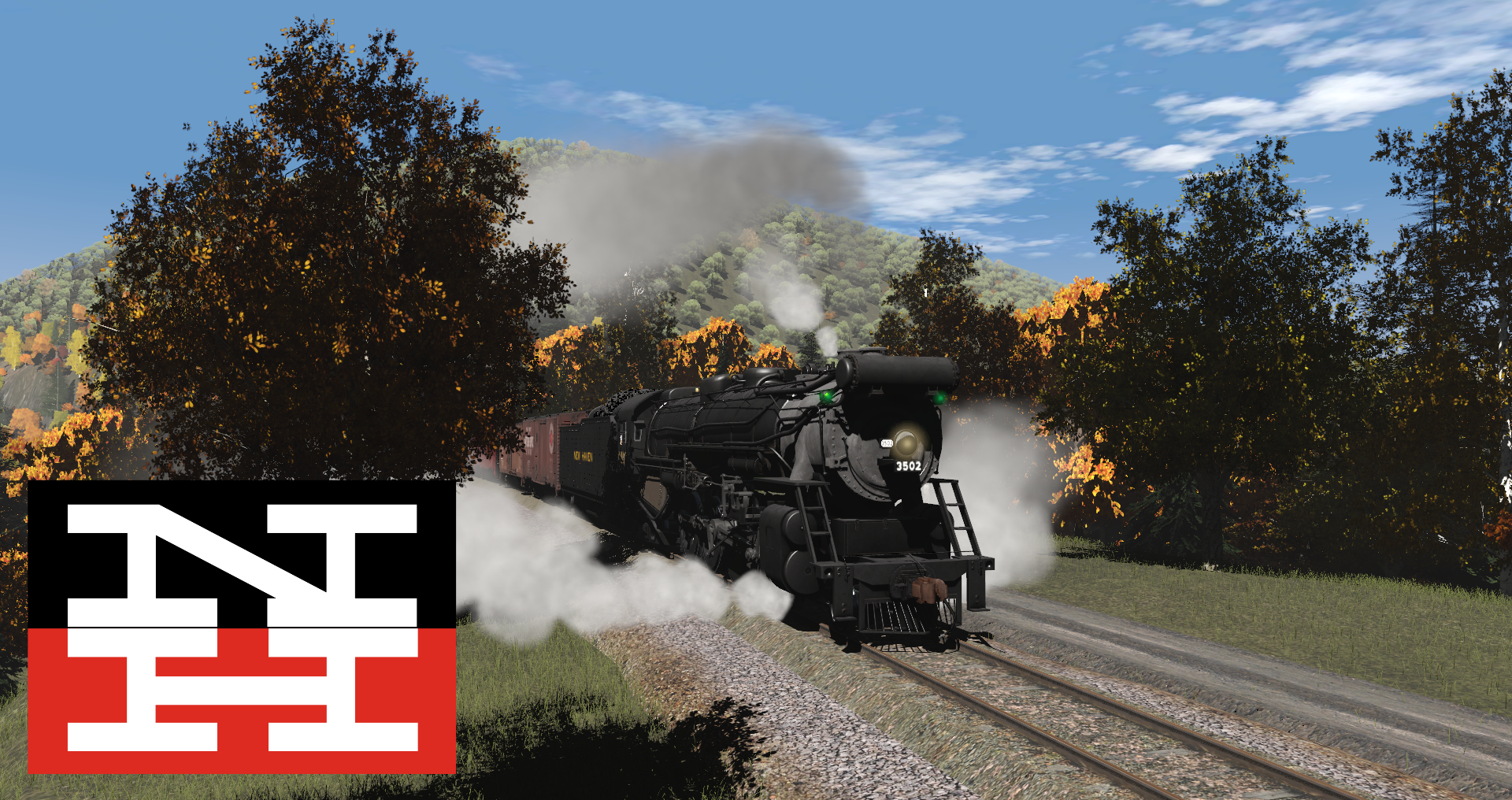

R-2 3500 was the precursor of twenty additional high horsepower Mountain-type engines of similar design. All twenty-one were built by Schenectady starting with 3500 in 1924, 7 additional R-2's in 1926 distinguished by high boiler pressure (3501-07), three R-3's with three cylinders in 1926 (3550-52), and ten more in 1928 (3553-62). All were equipped with water-tube fireboxes which were not successful and soon replaced. Ultimately all New Haven engines originally delivered with the McClellon boiler had a conventional boiler fitted in 1929. The specs refer to the later boiler, whose firebox heating surface area included 101 sq ft (9.38 sq m) in the combustion chamber and 95 sq ft (8.83 sq m) of thermic syphons. Other problems included a balky DuPont-Simplex mechanical stoker (replaced by an HT-2 in the 1930s) and Southern valve gear replaced by Walschaerts or Baker gear. The design also came equipped with a feedwater heater and a valve motion with limited cutoff. 14" (356 mm) piston valves supplied steam to the cylinders. The R-2s ran until 1949-1951.
2021
+UPDATE
-Texture Change
-UV Map Revamp
-Better PBR
-Removable Crew Figures
-New Sounds
-Better Cab
TRS2019 and up!
Please backup your downloads upon purchase! Check the FAQ section for more information.

The MT-3 were the third batch of Mountain-type locomotives for the Southern Pacific. The original MT-1 class had been produced by ALCO, but all succeeding classes had been built in house at the SP’s Sacramento shops. The five classes of mountain’s differed little in mechanical specifications but had differences in cosmetic appearances. Skyline casings across the top of the locomotives was common retrofit to this type of engine
Includes
SP Engine MT-3 4-8-2
SP Engine MT-3 4-8-2 (Skyline)
SP Engine Tender 120-C-8
SP Engine Tender 160-C
Custom Cab
Bodygroups / Toggle Meshes Feature "Engine" (3 Variants)
Skins Feature "Engine" (12 Variants)
Tender Feature's a working Headlight
MISSING DEPENDENCIES ISSUES
Check Download Station for extra missing content
Also, check the Missing Dependencies section of the website
TRS19 and above
Please backup your downloads upon purchase! Check the FAQ section for more information.


Built for the Pennsylvania Railroad, the B6 class was a rugged 0-6-0 steam switcher designed to handle yard duties and short transfer runs with ease. These locomotives were the backbone of PRR’s terminal and industrial switching fleet from the early 1900s through the steam era’s twilight.
The B6 combined a compact frame with impressive tractive effort, making it ideal for tight yards and heavy cuts of freight cars. With its signature Belpaire firebox, classic PRR styling, and powerful yet practical design, the B6 was an iconic sight in yards across the Northeast and Midwest.
This model has been faithfully recreated for Trainz, capturing the distinctive proportions and detailing of the B6 class. It’s perfect for anyone who loves PRR steam or enjoys operating prototypical switching scenarios.
Features:
Accurate PRR B6 exterior with authentic Belpaire firebox
Freeware release for the Trainz community
Bring a piece of PRR’s hard-working steam history to your yards and industrial branches.

The PRR C1 was the Pennsylvania Railroad's class of 0-8-0 steam locomotive, used in switching service. The 0-8-0 was common on most railroads, but not on PRR; when the railroad needed bigger motive power, they used the 2-8-0 "Consolidation". PRR wanted the best motive power to handle the switching chores at yards and interchanges and the C1 class was the heaviest two-cylinder 0-8-0 switcher ever produced. Calculated tractive effort was 76154 lb, based on 78% MEP with 60% maximum cutoff. All C1s were retired between 1948 and 1953, none being preserved.
Includes
PRR C1 Locomotive
3 PRR Tenders (3 Styles)
Custom Cab
MISSING DEPENDENCIES ISSUES
Download the PRR B6 if you are missing the tender truck dependencies
Check Download Station for extra missing content
TRAINZ 2019 and up!
Please backup your downloads upon purchase! Check the FAQ section for more information.

The extra dependencies for this are located on the download station.
TRAINZ RAILROAD SIMULATOR 2019 AND UP!

Class E6 on the Pennsylvania Railroad was the final type of 4-4-2 "Atlantic" locomotive built by the railroad, and second only to the Milwaukee Road's streamlined class A in size, speed and power. Although quickly ceding top-flight trains to the larger K4s Pacifics, the E6 remained a popular locomotive on lesser services and some lasted to the end of steam on the PRR. The E6 was designed by the Pennsy's General Superintendent of Motive Power, Lines East, Alfred W. Gibbs, and his team. They produced an Atlantic of modern design, featuring a large and free-steaming boiler, outside Walschaert valve gear, piston valves on the cylinders, and a cast steel KW pattern trailing truck designed by the PRR's Chief Mechanical Engineer, William F. Kiesel, Jr. Modern features never present on the E6 design, and never retrofitted, included the mechanical stoker, power reverse and feedwater heater. To learn more, click here -->This<--
Includes
4 PRR E6s Locomotives (4 Variants)
2 PRR Tenders (PRR & Long Island)
Custom Cab
MISSING DEPENDENCIES ISSUES
Download the PRR B6 if you are missing the tender truck dependencies
Check Download Station for extra missing content
TRAINZ 2019 and up!
Please backup your downloads upon purchase! Check the FAQ section for more information.

The extra dependencies for this are located on the download station.
Trainz Railroad Simulator 2019+

The extra dependencies for this are located on the download station.
Trainz Railroad Simulator 2019+

The first one to ever see a simulator, the Pennsylvania Railroad's class H6, H6sa, and H6sb steam locomotives were of the 2-8-0 "Consolidation" freight type, the most numerous class on the railroad with 2,032 units, and the second most prolific 2-8-0 class in North America, with the USATC S160 class rostering 88 units more. Class H6 were used throughout the system as mainline freight haulers, on local freights, and as switchers in yards. They were frequently seen double- and tripleheading long freight trains up the steep grades on the Pennsy. During the period when the PRR was building the H-6 class, the railroad had effective stock control of the Baltimore and Ohio Railroad, and installed a PRR vice-president Leonor F. Loree, as president of the B&O. Subsequently, the B&O bought a large group of identical locomotives from the American Locomotive Company; these were initially classified class I-4, later becoming class E-24. The E-24 class had many variations, some being converted to switchers, or receiving superheaters and new valve chests. The E-24a was equivalent to the PRR H-6sb.
Includes
2 PRR H6sb Locomotives (2 Variants)
2 PRR Tenders (Type A and B)
Custom Cab
MISSING DEPENDENCIES ISSUES
Download the PRR B6 if you are missing the tender truck dependencies
Check Download Station for extra missing content
TRAINZ 2019 and up!
Please backup your downloads upon purchase! Check the FAQ section for more information.

The extra dependencies for this are located on the download station.
TRAINZ RAILROAD SIMULATOR 2019 AND UP!

The Pennsylvania Railroad's class Q2 comprised one prototype and twenty-five production duplex steam locomotives of 4-4-6-4 wheel arrangement. They were the largest non-articulated locomotives ever built and the most powerful locomotives ever static tested, producing 7,987 cylinder horsepower (5,956 kW) on the PRR's static test plant. They were by far the most successful duplex type. The duplex propensity to slip was combated by an automatic slip control mechanism that reduced power to the slipping unit. The Q2 locomotive was 78% more powerful than the locomotives that PRR had in service at the time, and the company claimed the Q2 could pull 125 freight cars at a speed of 50 mph (80 km/h). These were an improved version of the previous Q1 class, which was a 4-6-4-4 dual-purpose engine instead of a 4-4-6-4 freight engine. Despite the overall success, the Q2s were all out of service by 1951. With dieselization, they were the obvious first targets to be withdrawn since they were only a little more capable than the conventional J1 class 2-10-4s but with far higher operating and maintenance costs. The final Q2, 6199's power output is 7,987 hp. All have been scrapped and none are preserved.

The extra dependencies for this are located on the download station.
Trainz Railroad Simulator 2019+
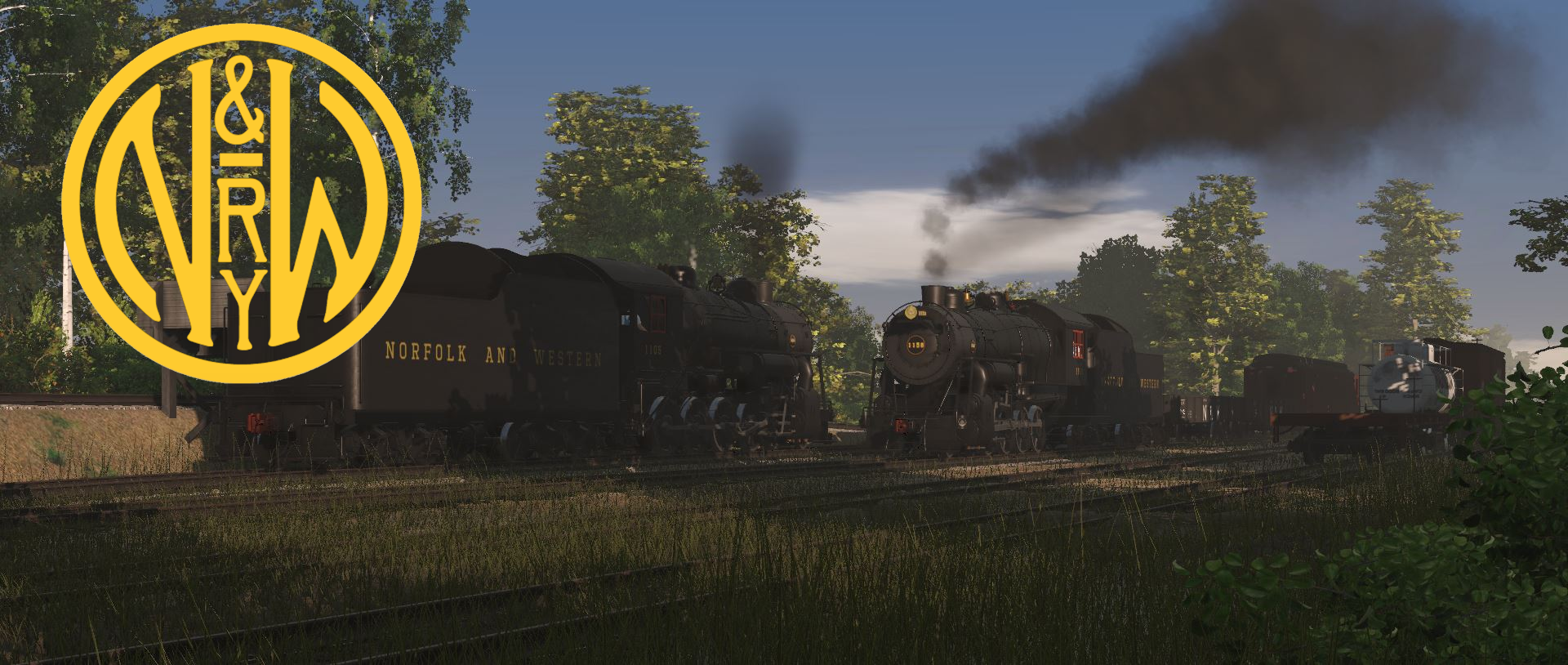
The Norfolk and Western M2's, built in 1910 by the Baldwin Locomotive Works, where the last and heaviest 4-8-0s in the US. The M2 was the successor to the Class M and M1 and sported a larger boiler and improved walschaerts valve gear. Although more powerful than the M's, the M2s were notoriously poor steamers due to their smaller fireboxes and rode extremely rough. Regardless of their short-comings, the M2s would survive through to the late 50's as they where the heaviest non-articulated freight locomotives ever built for the N&W and where seen primarily on heavy ore drags.
Creators
Dennis - Modeling
Elijah - Texturing & Coding
Includes
N&W M2 Locomotives
N&W Tender
Custom Cab
TRS19
Please backup your downloads upon purchase! Check the FAQ section for more information.


Built in 1916 as Munising, Marquette & Southeastern Railway, these massive 2-8-0’s were specially designed for service on heavy iron ore trains in Michigan’s Upper Peninsula. Eventually with the MM&SE merger with the Lake Superior & Ishpeming Railroad, these engines were relettered and renumbered as LS&I numbers 32, 34 and 35. Developing a whopping 72,309 pounds of tractive effort with its rare tender steam booster engine cut-in, this engine and tender had more low-speed pulling power than many larger locomotives.
Includes
LS&I Engine SC-1 2-8-0
LS&I Engine Tender
LS&I Engine Tender Booster
Custom Cab
Bodygroups / Toggle Meshes Feature "Engine" (5 Variants)
Skins Feature "Engine" (8 Variants)
Tender Feature's a working Headlight
MISSING DEPENDENCIES ISSUES
Check Download Station for extra missing content
Also, check the Missing Dependencies section of the website
TRS19
Please backup your downloads upon purchase! Check the FAQ section for more information.


The Texas & Pacific I-1a were the second batch of 2-10-4 type steam locomotives built by the Lima Locomotive Works. Their road numbers were 610 - 624, and arrived between 1927-1929. They would serve the T&P till the early 1950’s when the railroad would dieselize. Today class leader #610 survives at the Texas State Railroad Museum
Includes
T&P Engine I-1a 2-10-4
T&P Engine I-1a 2-10-4 Tender
Custom Cab
Bodygroups / Toggle Meshes Feature "Engine" (3 Variants)
Skins Feature "Engine" (8 Variants)
Skins Feature "Tender" (4 Variants)
MISSING DEPENDENCIES ISSUES
Check Download Station for extra missing content
Also check the Missing Dependencies section of the website
TRS19
Please backup your downloads upon purchase! Check the FAQ section for more information.


The U4a class 0-8-0s (numbers 100-102), were built for the Indiana Harbor Belt Railroad in 1927 by Alco Brooks. These heavy 3-cylinder 0-8-0s known as "Super Switchers" packed a powerful 89,500 pounds of tractive effort, making them the most powerful engines on the roster, out pulling even their 2-8-2s. These engines also had booster engines on the lead trucks of their tenders, creating a high starting tractive effort.
Includes
1 IHB - U4a Locomotive
3 Tender Variants
Custom Cab (All of my locomotives will have custom cabs)
MISSING DEPENDENCIES ISSUES
Check Download Station for extra missing content
TRAINZ 2019 and up!
Please backup your downloads upon purchase! Check the FAQ section for more information.
Due to the importance of the Panama Canal during WW2, the Panama Railroad Company would order five new 2-6-0 moguls to supplement their fleet. With 63in driving wheels and producing 28,400 pounds of Tractive Effort, these engines were ideal for freight and passenger service. The five engines would serve from 1940 till 1947 when the PRR would dieselize, all would be scrapped serving only seven years.
Includes
2 Panama Railroad Locomotives (2 Variants)
Custom Cab
MISSING DEPENDENCIES ISSUES
Check Download Station for extra missing content
TRS19
Please backup your downloads upon purchase! Check the FAQ section for more information.
Dependences / Scripts

American Knuckle Coupler Dependence
<kuid:719064:100279> American Knuckle Coupler
<kuid:719064:100793> American Knuckle Coupler v2
<kuid:719064:100794> American Knuckle Coupler v2 Mesh Asset
Coupler Asset v2, Can be used to replace the existing coupler or used to fix Missing Dependencies.<kuid:719064:100793> American Knuckle Coupler v2
TRAINZ RAILROAD SIMULATOR 2019 +

This is the Livery Swap Script Library that is used to swap the skins and control the bodygroups on the Trainz Content. This script is available for others to utilize to their liking or modify to their needs.
<kuid:719064:100756> Livery Swap Script Library
Feel free to modify and use with permission mentioned here from Greencoast Studios.

Locomotive Scripts
In the earlier days of Trainz development, assets and custom scripts often worked reliably across builds. We created a library of scripts at Greencoast Studios under those stable conditions, confident they’d run in user-assets, builds, and derivatives.
However, as the Trainz series moved forward with major updates and service packs (for example the release of SP 5 for TRS19) the underlying build numbers, asset compatibility and scripting engine behavior changed.
Specifically, many users in the community reported that after upgrading to new builds or cloning assets:
Scripts would fail to compile or produce “RED Bug” errors in the log. Trainz
Older functions or tags became deprecated, changed or broken— meaning the same script logic would no longer run as expected.
Builds labeled as “Trainz-build X.X” would declare that content saved in that build was not compatible with older versions.
Some script behaviors, asset dependencies and library links started failing when extending or modifying assets for newer builds.
In short: as Trainz evolved, our scripts and many other creators’ scripts began to feel brittle under new builds and changes in the engine. Instead of being “write once, run many” they required maintenance, fixes, and updates that individual users didn’t always have time for.
Why We’re Releasing Them Publicly
We believe that the creative modding community deserves access to solid script foundations. So we’re offering the full library of Greencoast Studios’ locomotive script files for public use, with the intention that you as a modder, scripter or asset maker can:
Use them as the starting point for your own projects.
Dive in, fix, modify, repair or extend them for your build, your version of Trainz, and your needs.
Share improvements or custom adjustments back with the community if you like.
This is us saying: we’re handing the keys over so you can make them work for your version, for your asset, for your audience. Rather than keeping everything locked away and hoping it just “works”, we recognize the past struggle of script breakage and want to help the community flourish.
Usage Rights & Permissions
By downloading this release, you are granted full permission to:
Use the scripts in personal or commercial Trainz content.
Modify, repair, extend, update, or re-script as required to fit your version of Trainz, or to fix new build incompatibilities.
Re-distribute the modified scripts (or portions thereof) as part of your assets or tools, provided you include a credit to Greencoast Studios (for example: “includes portions of code by Greencoast Studios – Trainz Script Library (Open Release)”).
No further permission from us is required. We encourage you to experiment, adapt, and share improvements with the broader community.
Disclaimer
These scripts are provided as-is. Greencoast Studios cannot guarantee fault-free behavior, and we accept no responsibility for side effects, asset conflicts or version incompatibilities you may encounter after modifying them. Your usage, modifications and distributions are your own responsibility.